
No water quality impact from long-drop
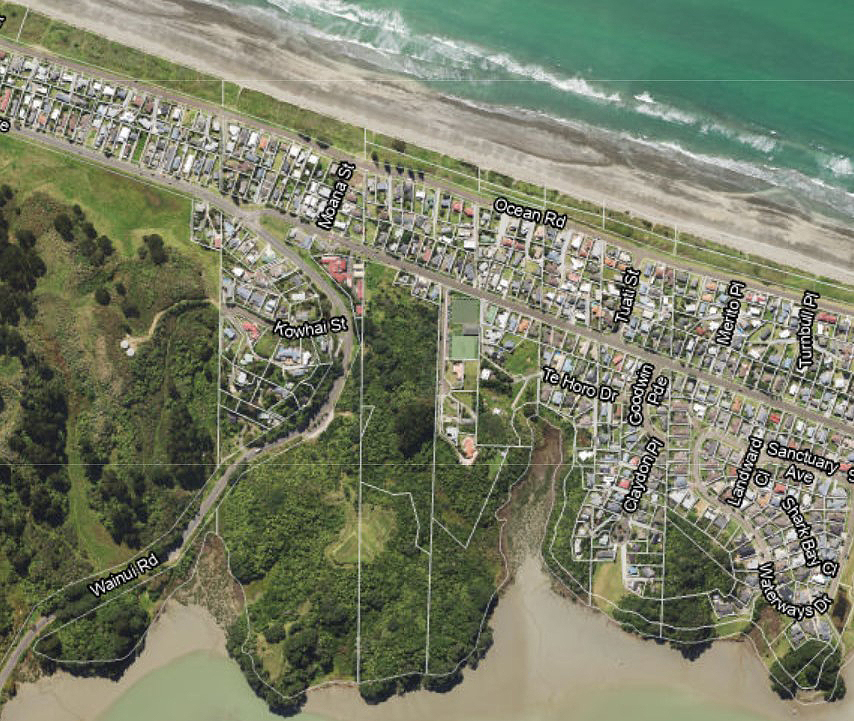
Testing target: The area of Ōhope Bay of Plenty Regional Council has been testing for groundwater contamination since early November when a long-drop toilet was discovered on a property.
Diane McCarthy
After six weeks of testing around Harbour Road, Ōhope, Bay of Plenty Regional Council has found no impact to groundwater quality from a long-drop toilet discovered on a property in the neighbourhood.
As a precaution, public health advice is still to avoid drinking from bores, using it for watering food gardens or for home recreational activities, such as paddling pools and kids’ sprinklers, until the long drop is removed.
The regional council completed its assessment of groundwater quality around the western end of Harbour Road last week.
The assessment began in early November following the discovery of a pit latrine (long drop) on one property.
Due to the shallow nature of the groundwater in this area and the presence of permeable materials such as sand, gravel, and pumice, the regional council felt there was an increased risk that contaminants may move quickly through the aquifer.
Many domestic bores in the vicinity are shallow and may have drawn water from the same layer, making them more vulnerable to contamination.
The regional council reported last week that four high-risk bores were sampled throughout November, including after rainfall.
All results met drinking water standards, with no E. coli detected and only one very low-level faecal coliform result.
Nitrate levels were below maximum allowable values. Overall, sampling suggested that the long drop had not impacted groundwater quality.
However, due to the shallow aquifer, there could still be a risk until it is decommissioned.
No further routine sampling was required at that stage, but a follow-up test would be done after the long drop has been decommissioned.
The regional council said if people had any questions or concerns, or wished to report any environmental pollution, to call its 24/7 Pollution Hotline on 0800 884 883.